
A Notebook Left Open in Kolkata


These are observations from a month spent in Kolkata in April 2026, assembled from notes taken separately across different days and different moods.
There is a billboard that stalks the visitor across Kolkata. Advertising a residential project in Rajarhat named DTC Downtown, it carries a tagline of accidental, devastating profundity. The best of the city. Without the rest of the city. I encountered it on the airport approach, over the flyovers, along the bypass. Its ubiquity was appropriate, for the structural condition it advertises is now the defining reality of the metropolis.
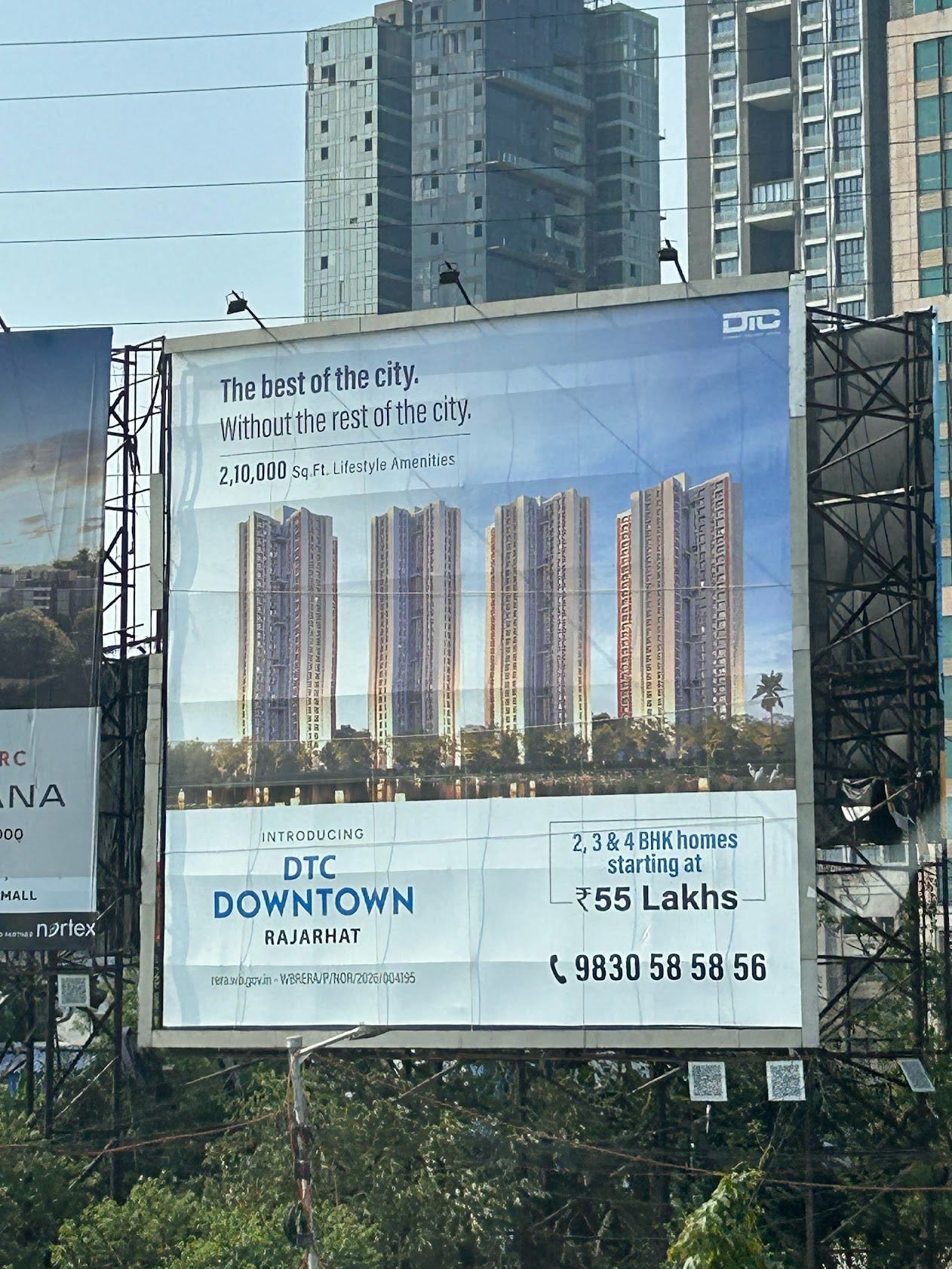
Kolkata is a city where insulating oneself from abject poverty is an impossibility. Geoffrey Moorhouse once remarked that India had beggary everywhere, but only Calcutta elevated it into an entire urban landscape. The city confronts visitors with scenes that feel medieval in density and modern in scale, broken bodies at crossings, children sleeping against colonial facades, misery woven into the rhythm of commerce itself.
The metropolis has resolved this through the gated community. A securitised enclave where private fortune can be exhibited without the inconvenience of public consequence. The explosion of private security guards across the newer quarters is not merely a response to petty crime. It is a semiotic broadcast. The guard at the gate is the ultimate status signal, the physical manifestation of a quiet two-decade project of bourgeois secession. Downtown simply has the cold honesty to say the quiet part aloud.
A brief detour into the North 24 Parganas is instructive. Chandraketugarh is a ~2,400-year-old settlement whose soil is littered with Roman amphorae. Before Kolkata existed, Bengal was trading with the Mediterranean.
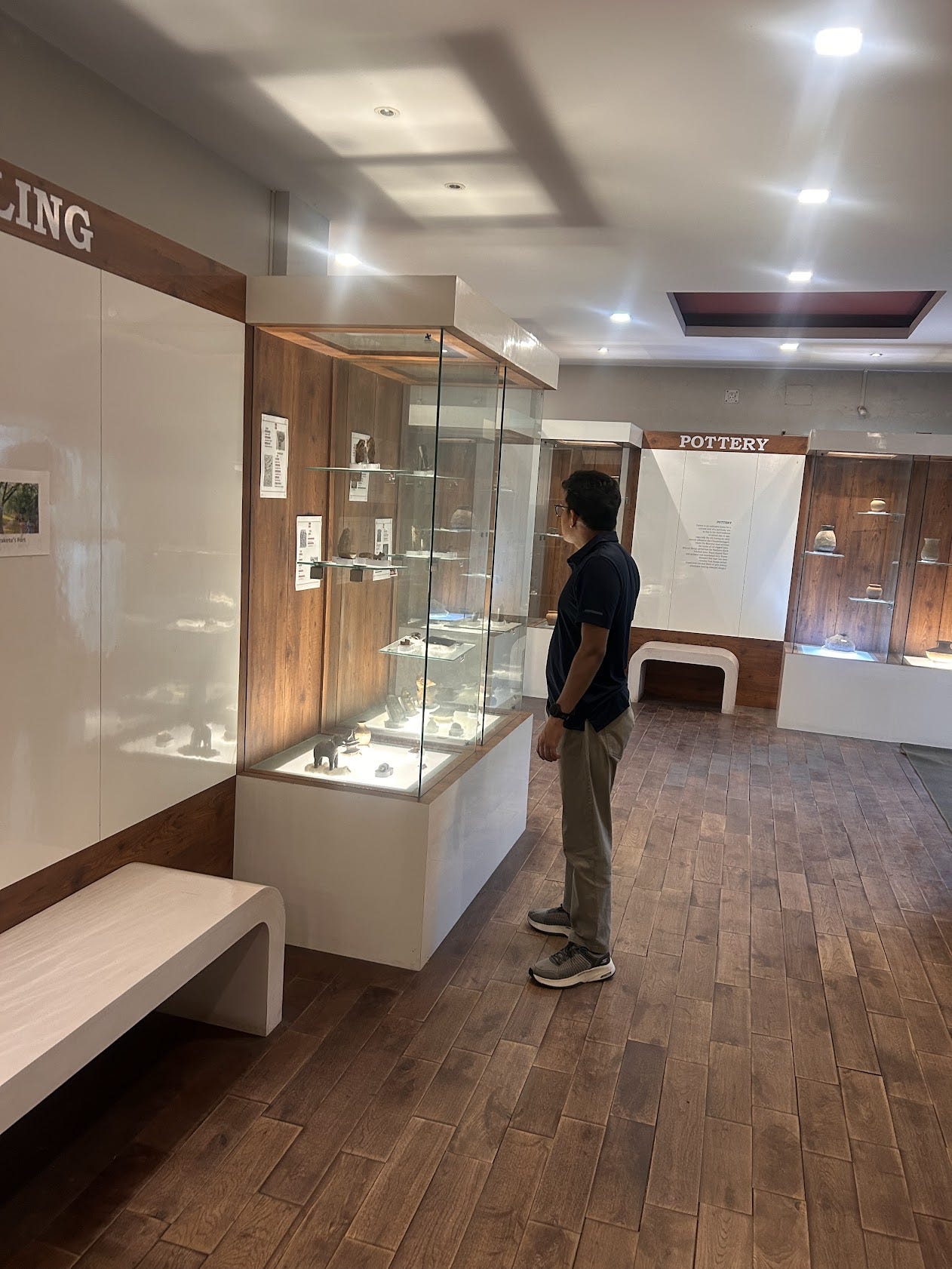
It was a culture that was outward-facing, sophisticated, and deeply integrated into the currents of global commerce. The state manages to curate the museum of this dead civilisation with reasonable competence. It is the living civilisation that defeats it.
Drive south toward Sagar Island, and the Hooghly opens into an inland sea of almost Amazonian proportions. Organised industry vanishes, replaced by fishing hamlets and the slow rosary of brick kiln chimneys.
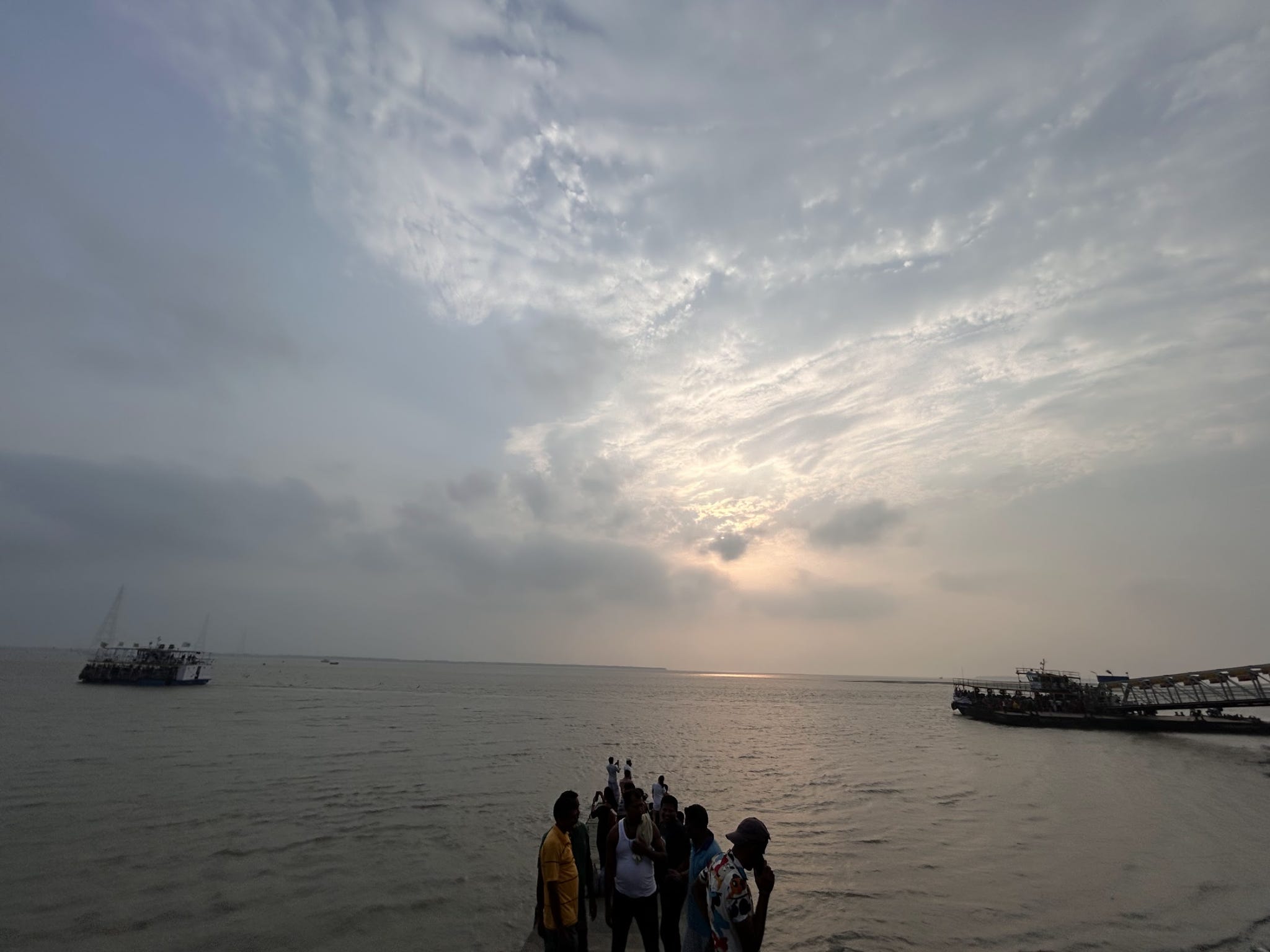
The popular saying goes sare tirath baar baar, Gangasagar ek baar, all other pilgrimages may be made repeatedly, but Gangasagar once is enough. In premodern times, the journey down this river to the confluence was genuinely perilous. Even now, it is not a smooth experience. The pilgrims who come in wade through conditions that communicate, more clearly than any policy document, what the state actually values. Electricity arrived on the island only in 2012, through a project funded by the World Bank.
A Bhadralok friend of mine, a man with a serious appetite for geopolitics and a neighbour of the family of the late Bimal Krishna Matilal, offered me the most elegant theory of Kolkata I have encountered. Despite the Ganga flowing through it, he observed, the city draws its water overwhelmingly from trapped sources. Ponds, wells, groundwater. This is not incidental. It is structural. Kolkata does not draw from flow. It draws from what has already been stopped. The observation extends, he suggested, into everything else. People, place, time. All stand still. Nobody needs to be anywhere else. They are simply stuck, and the stuck condition has been administered so long that it has acquired the dignity of a philosophy. The Ganga passes through the city. The city drinks from ponds.
Mumbai teaches hustling. Kolkata teaches rent-seeking, in whatever form it presents itself. The margin shaved from a deal, the penny prised from a transaction, the power that accrues to whoever controls the chokepoint. Mumbai thrives on flow because flow generates surplus. Kolkata thrives on blockage because blockage generates dependency, and dependency, in Bengal’s political economy, is the most durable form of capital.
This is not merely a cultural observation. It has infrastructure to match. The ticket counter of Victoria Memorial, the crown jewel of Kolkata’s colonial heritage and a monument administered not by a cash-strapped municipality but by the Ministry of Culture, Government of India, displays a laminated sign in a wooden frame: No online tickets. Only cash. In 2026, when a street vendor in provincial Uttar Pradesh will hand you a QR code, someone in the apparatus of the Indian state made an active decision that Bengal’s most famous monument would remain outside the digital economy.
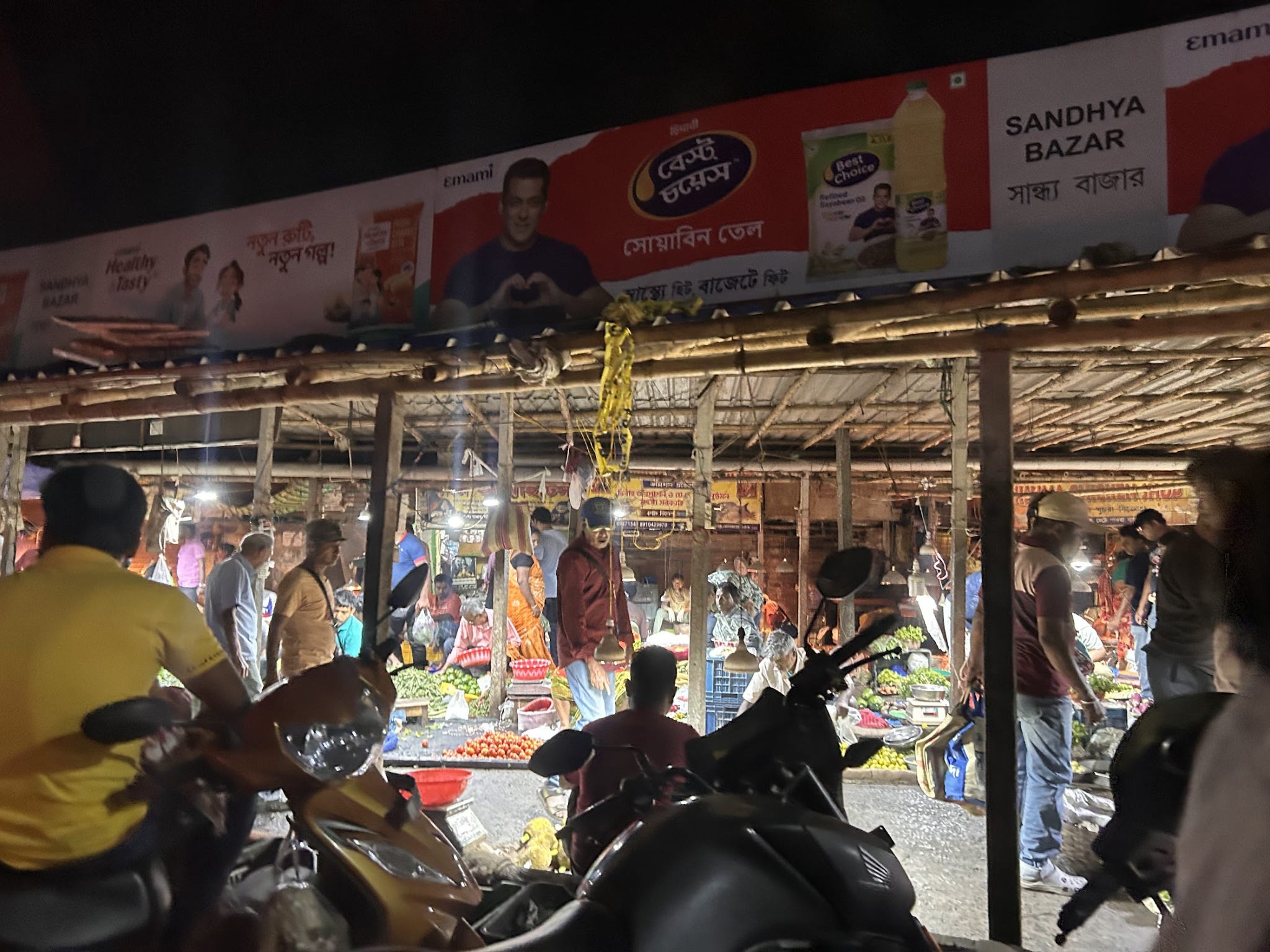
The informal markets of South 24 Parganas confirm the pattern. The digital financial spine that has connected the rest of India to its own growth simply stops here. Whether by design or by the accumulated neglect that serves the same function as design, the outcome is identical.
On the fourth of May, the BJP won 207 of 294 seats. History is not obliged to be ironic, but in this election, it indulged itself freely. The largest margin of victory, 104,265 votes, came from Matigara-Naxalbari, the crucible of the 1967 peasant uprising that gave birth to a generation of armed left-wing insurrection.
West Bengal’s Hindus, roughly seventy percent of the electorate, consolidated behind the BJP at unprecedented levels. The TMC’s historically reliable Muslim coalition fragmented. Consider what it required to lose. Mamata Banerjee ran a welfare apparatus that included direct cash transfers to women, the Ladli Behna logic applied to Bengal’s own fiscal constraints, alongside a 30% Muslim electorate that had delivered her three consecutive mandates. Neither was sufficient. A political machine that could not be saved by beneficiaries is not a machine that lost an election. It is a machine that exhausted the patience of everyone it claimed to serve.
Until this result, Bengal was the grand exception. The one major state where the cultural logic of Hindu nationalism appeared to evaporate upon contact with the electorate. This exceptionalism was underwritten by Leftist intellectual hegemony and the conceit that Bengal was too refined for the so-called communalism of the Hindi heartland. That the same Bengal had, a century earlier, produced the more intellectually rigorous strand of that very nationalism was a detail the exceptionalism conveniently forgot.
That exception is now closed.
The aggregate numbers tell one story. The roads tell another. In rural Bengal, particularly in areas where the demographic balance has shifted decisively, one notices something the data cannot capture: on the windshield of e-rickshaws, on motorcycles, on the foreheads of their riders, the Urdhva pundra. There is also a detail that the national pattern does not prepare you for. The BJP everywhere else is an urban party. It takes the cities and works outward. In Bengal, it took the villages first.
Nirad Chaudhuri probably saw this coming. In Atmaghati Bangali (literally The Suicidal Bengali), he identified what the Bengali intelligentsia had done to Chaitanya: rendered him perpetually lost in Bhavasamadhi, ecstatic rapture, a saint wholly absorbed in the divine and therefore conveniently absent from the world. This was a deliberate taming of a forceful original.
The historical Chaitanya was a man of six feet two, physically commanding, whose presence in the streets of Nabadwip and Puri drew crowds and unnerved authorities. The sixteenth-century Vaishnava movement he founded had been genuinely radical. It placed the experience of God not in renunciation or ritual hierarchy but within the textures of ordinary human feeling, love, longing, grief. Sudipta Kaviraj noted that no other religious tradition had the daring to humanise divinity so completely. The Bengali intelligentsia made him safe by making him ethereal.
What the broader Hindutva upsurge has done, over decades and now visibly in this result, is re-world him: returned a devotional tradition to the political and social terrain it once claimed. The villages moved before the commentators noticed.
The ideological victory for the BJP is total. The responsibility it inherits is correspondingly vast.
Map this result against the last four years, and a geopolitical pattern emerges that the republic has not seen since 1947. The BJP now commands a vast eastern arc. Bihar, Odisha, Chhattisgarh, Assam, and Bengal. For the first time in modern Indian history, a single political formation controls the entire eastern flank of the subcontinent.
To grasp the magnitude of this, one must take the longue durée view. For two centuries, Calcutta was the most consequential port city in Asia. The Left and TMC’s historical achievement is the systematic dismantling of this inheritance, not through a single cataclysm, but through the grinding daily work of making enterprise suspect and accumulation embarrassing. The result was the political administration of a prime coastal geography into total economic irrelevance.
The current China-plus-one realignment is the first external macroeconomic shock in half a century capable of reversing this trajectory. Capital, when it moves, follows a specific sequence of conditions. Low labour costs, cheap land, deep-water ports, logistics connectivity, and political stability. The eastern arc possesses all of these. What it lacked, until now, was the political coordination required to string them together. Bengal had functioned as a structural veto player, a hostile border state that treated inbound investment as a threat to its patronage networks. That veto has been removed.
The Union government must reconceive Purvodaya as a ruthless, coordinated industrial strategy, requiring labour frameworks, investment promotion, and port expansion designed to turn the eastern seaboard into India’s equivalent of the Pearl River Delta.
In 1980, the Pearl River Delta in China was a high-biomass, low-capital agrarian swamp. It was transformed not by geography, but by a sovereign decision to treat prosperity as a governing obligation.